TWENTY-THREE YOUTH ATHLETES ATTENDED THE WEEKEND SESSIONS.
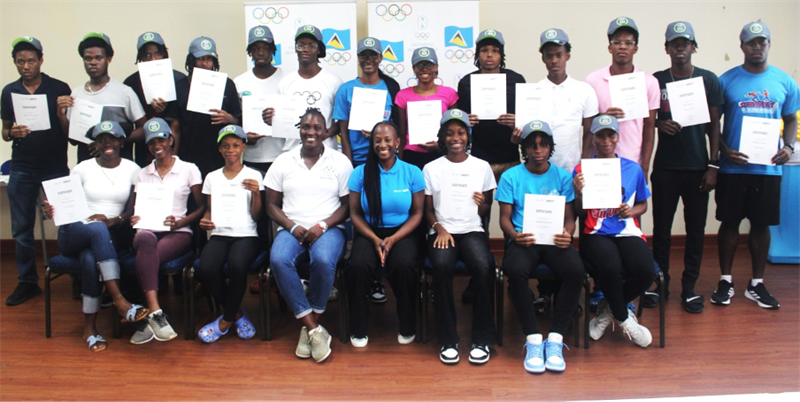 The Saint Lucia Athletes Commission (SLAC) hosted its first-ever athlete career workshop from November 22-23, 2025, at Olympic House in La Clery, Castries. The weekend sessions attracted twenty-three youth athletes from various sporting disciplines.
On the first day, the facilitator presented on the topic, “Power Up Your Future”, during which the young athletes were able to gain insights, identify their strengths, and get motivated. Session one focused on Strengths and Values, session two on Interest and Skills, session three on Passion and Impact, and session four on Purpose and Planning.
On the second day, the athletes learned what it takes for “Writing a Winning CV/Résumé”. A CV/résumé is a short, standout document that summarizes a person’s skills, character, experience, and achievements. It can be viewed as a marketing document presenting that person in a light that is persuasive for the job they are applying for.
The participants also engaged in group activities that included problem-solving and were issued certificates of participation and Athlete 365 caps.
The workshop facilitator was Mrs. Hazel Ann Regis-Buckels, Athletes Chair for the Grenada Athletes Commission. She’s also one of the educators for the Athlete 365 Career+ Educator Programme, which is hosted by the International Olympic Committee (IOC). Moreover, Regis-Buckels was a Semifinalist in the Women’s 400M at the 2004 Olympic Games in Athens, Greece.
“On the first day, we focused on self-discovery,” Regis-Buckels said following the workshop wrap-up. “As athletes, we often focus more on our performance, our competition, and not really pause to reflect on what’s next. The self-discovery workshop helped our athletes identify their superpowers: knowing their strengths, their values, their motivators, and what transferrable skills they can use to allow them to work in a space where they can use them.”
Regis-Buckels noted that these strengths help young athletes to create what is called ‘The Winning CV/Résumé’. This, she added, allows athletes to put together a résumé that makes them easily identified: their skills, their strengths, and, most importantly, who they are as a person.
She acknowledged that the athletes were very engaging despite enduring two days of very long hours. The first day’s session lasted six hours, while the second day’s session lasted four hours. She said many of the athletes were a bit hesitant initially, as they wondered why they needed to know all the information that was being shared. But after completing day two, they realized that one is never too young to truly understand the importance of who they are.
“It’s important that they know their inner strengths and superpowers now so that when they’re ready to transition – whether it’s retirement or to the next level – that they’re able to use those skills to land the perfect job,” said Regis-Buckels. “Most importantly, they must know what their values are and what companies out there align with their values.”
When asked about athletes now being able to benefit from self-development workshops that were not readily available in the past, Regis-Buckels admitted that many athletes like her wished they had such opportunities.
“We made decisions without this knowledge, and now we’re saying, ‘How can we use what is being given to us now by the International Olympic Committee?’ The IOC has a plethora of information and resources for athletes – not just Olympians. (The IOC) is now providing our athletes access to that information and those resources so that they can utilize it to make an impact in their lives. Without that knowledge, you’re not able to make informed decisions. So our goal as educators is to spend time in different countries educating our athletes by helping them understand the difference between being an athlete and being prepared for the real world.”
Regis-Buckels hosted the first workshop in Grenada, her home country, before coming to Saint Lucia for the second. She’s following up with another workshop in Trinidad in December. As a Caribbean region, she believes the continued encouragement of Athletes Commission Chairs, National Federations and athletes is important so they can make the best use of the resources and information being presented.
“The goal is to reach as many as we can, and in order to do that, we need them to understand the importance of it and also get the support we need,” she said.
Ms. Makeba Alcide, Chairperson of the St. Lucia Athletes Commission, said SLAC felt the need to host the workshop for young athletes to engage, learn their personality traits, and how to write a résumé.
“For us here in Saint Lucia, we believe that it was a workshop that needed to happen, so thanks to Athlete 365 and the IOC for making it happen,” Alcide, a former elite track athlete turned sports administrator, said. “Hazel was really an awesome facilitator and the athletes were very engaging. We got over twenty participants and for us that was meaningful, especially for our young athletes as they need to grow and develop not only as athletes, but also as individuals.”
As an administrator, Alcide said the most important part of the workshop was giving the young athletes the skills they need to continue developing: “As we know, not everyone lasts in sports for a long time, so there always needs to be a pathway after sports. We’ve learned that some of the athletes are artists and entrepreneurs and are still pretty young. Any way they can continue to hone those talents can help them develop and hone their brands. For me, it’s important to give the athletes some of the opportunities I didn’t have. As an athlete, it took me a while to get to where I am, and for them, the easier it is for them to get to that level, the better.”
This was SLAC’s final programme for the year; however, Alcide noted that SLAC intends to continue hosting the Career+ workshops in 2026. She said SLAC also hopes to continue hosting its athlete development workshops, coach development workshops, and national forums.
“We do have great sponsorship from Olympic Solidarity and Athlete 365, so we’re just hoping that we can use that sponsorship to host programmes like these to ensure that our athletes get the best of both worlds,” Alcide stated.
One of the workshop participants, Leneese Robinson, a track athlete, said: “I learned that as an athlete, I have skills and attributes that I can share in a workspace in the future.”
Another participant, Dante Henry, a long distance athlete, stated: “I learned that while being an athlete, I need to transfer my skills that I would have learned after I retire. I also learned that being disciplined and persistent will carry on into my workspace and make me a better person in the future.”